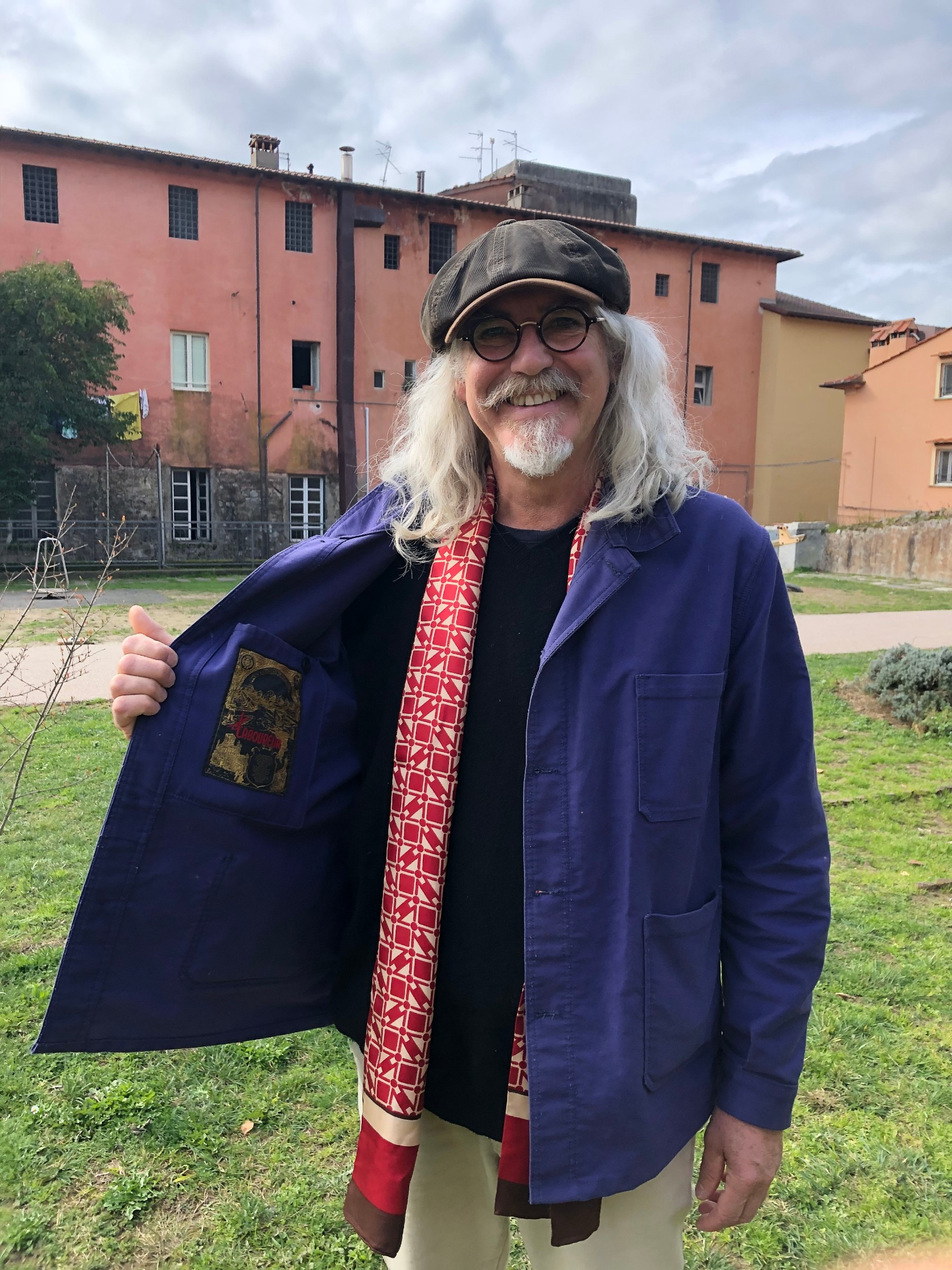
After what he describes as a ‘very free’ art education, Australian-born Michael Cartwright first came to Carrara in Italy 35 years ago with his wife Shona Nunan. Michael says ‘the main thing in my life is about creating something the whole time’ and discusses the many mediums he employs.
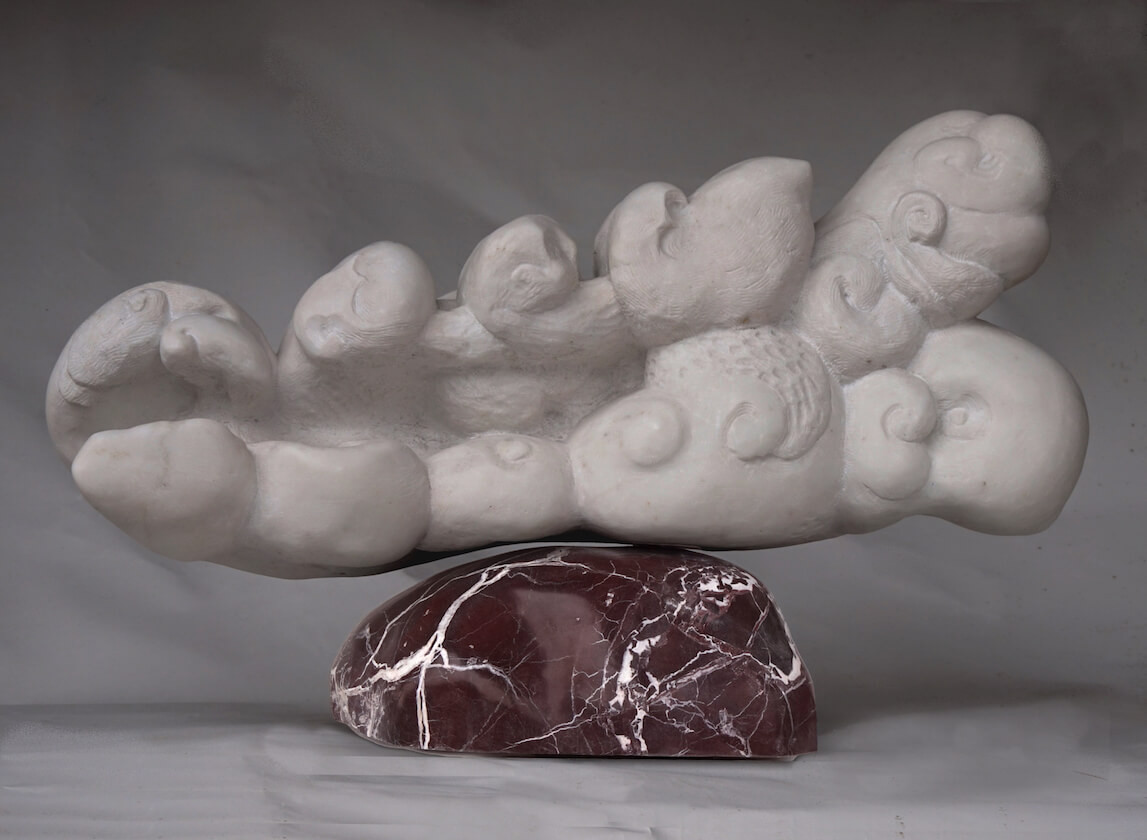
Michael Francis Cartwright, Cloud Passing Montefegetasi, 2017, statuario white and French red marble
Michael likes drawing, painting, printmaking, working with beautiful red hardwoods and carving marble. He also works with found objects and discarded items, ‘old toys, bits of stick, anything’, and takes them to the local art foundry to get them cast in bronze. Once, he ripped the back off an old truck and used the metal to make a sculpture.
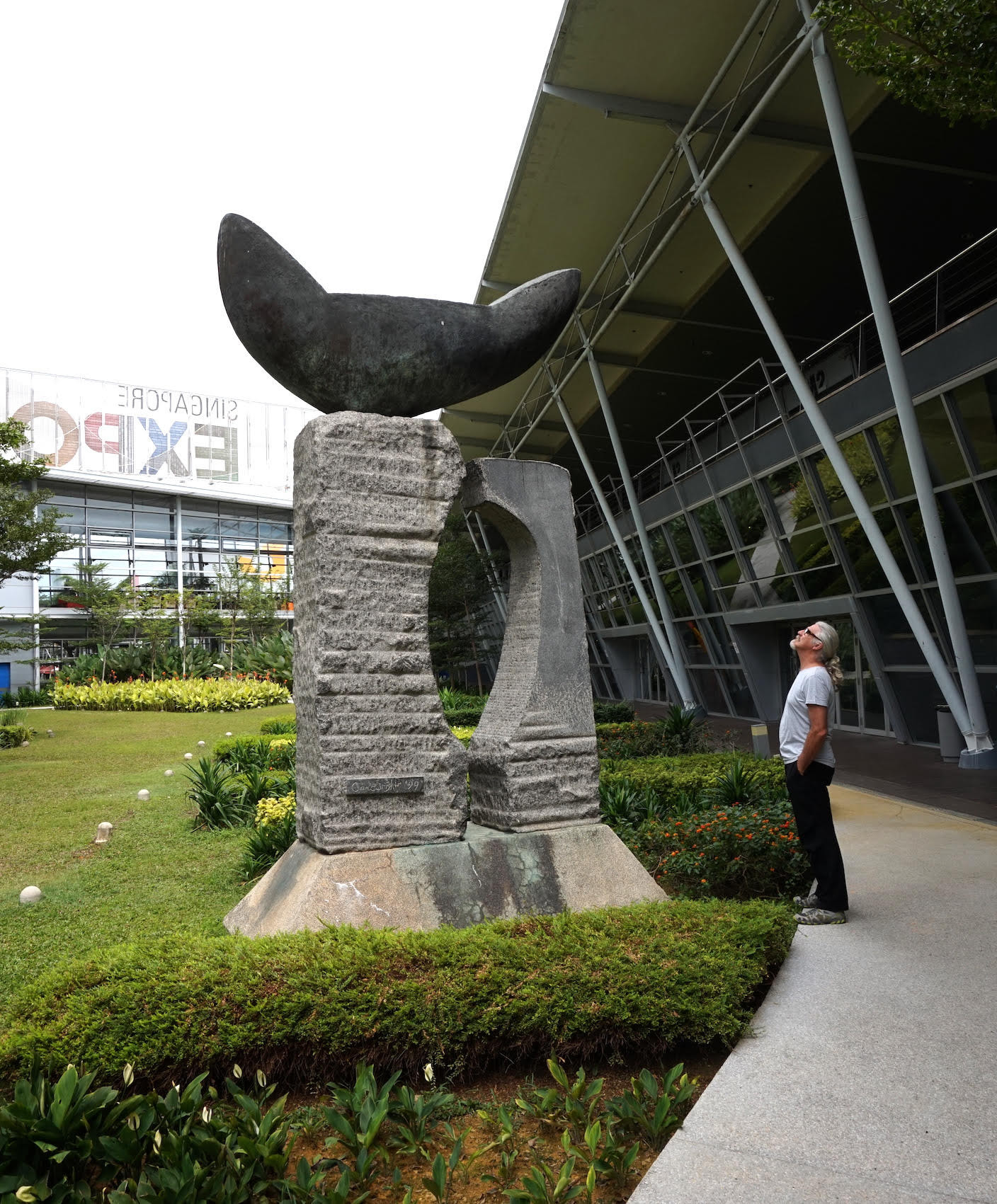
Michael Francis Cartwright, Passage, 1999–2000, bronze, granite, concrete, 5 × 3 × 1.5m, Singapore Expo building
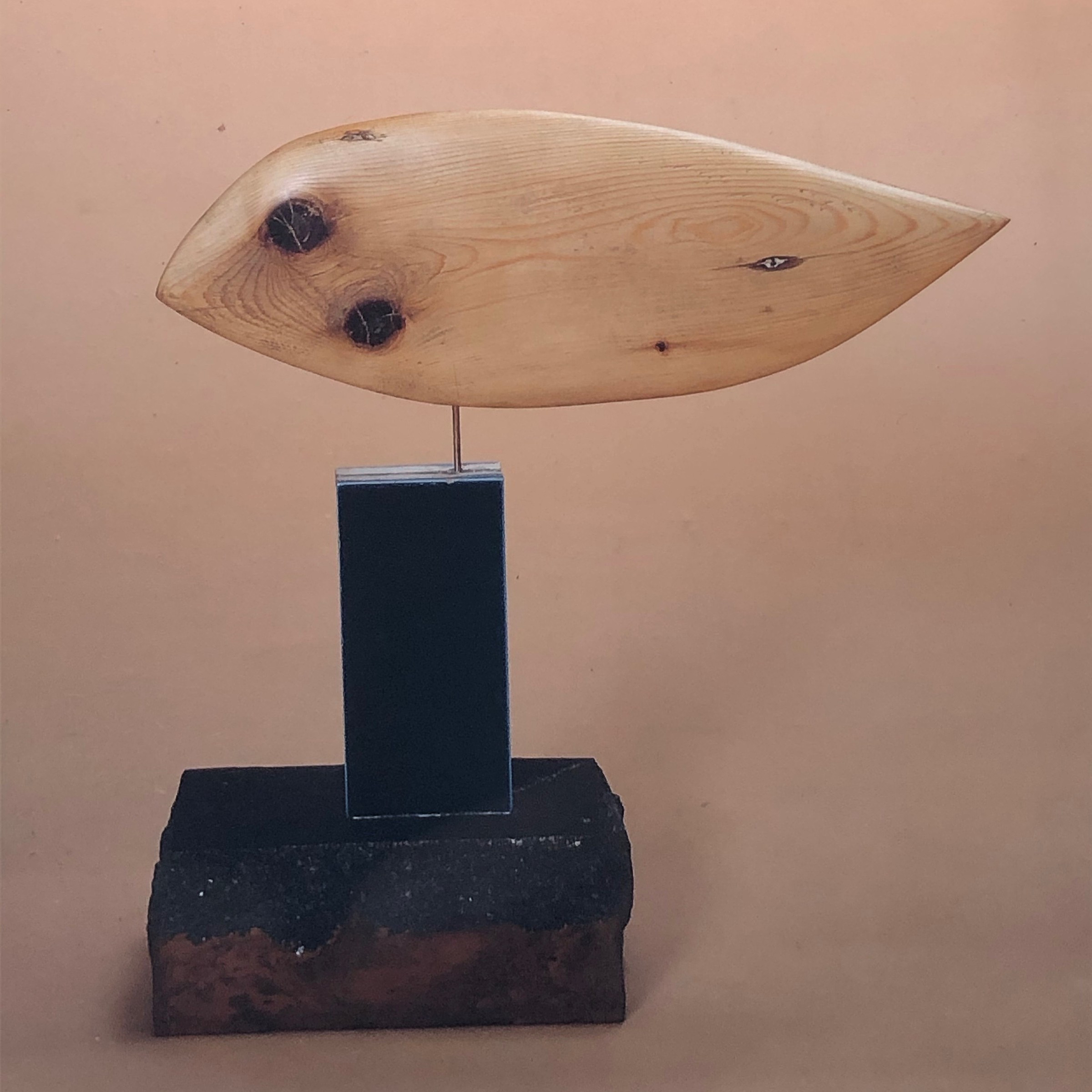
Michael Francis Cartwright, Fish Passing, reclaimed timber, brass rod, blue tiles, granite, gold paint
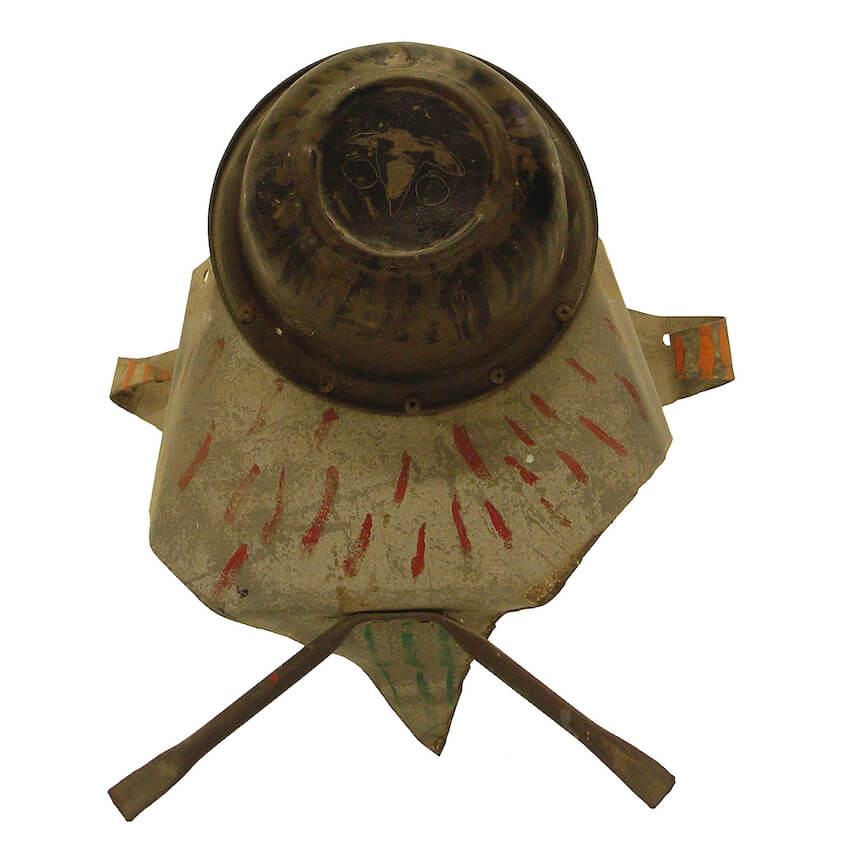
Michael Francis Cartwright, Owl, found objects: brass bowl, copper pipe, paint, tin from an old truck door
Recent inspiration has been clouds over hills and cliff forms. Michael also speaks of his affection for Australian birds which he draws and paints. He says the sulphur-crested cockatoo, the black-cockatoos with red or yellow plumes, ‘squawk and hang upside down and the farmers hate them. They eat all the rubbers [protecting] the nails on the roofs, the roofs fall off … and they eat all the seeds … but they're the most beautiful birds out.’
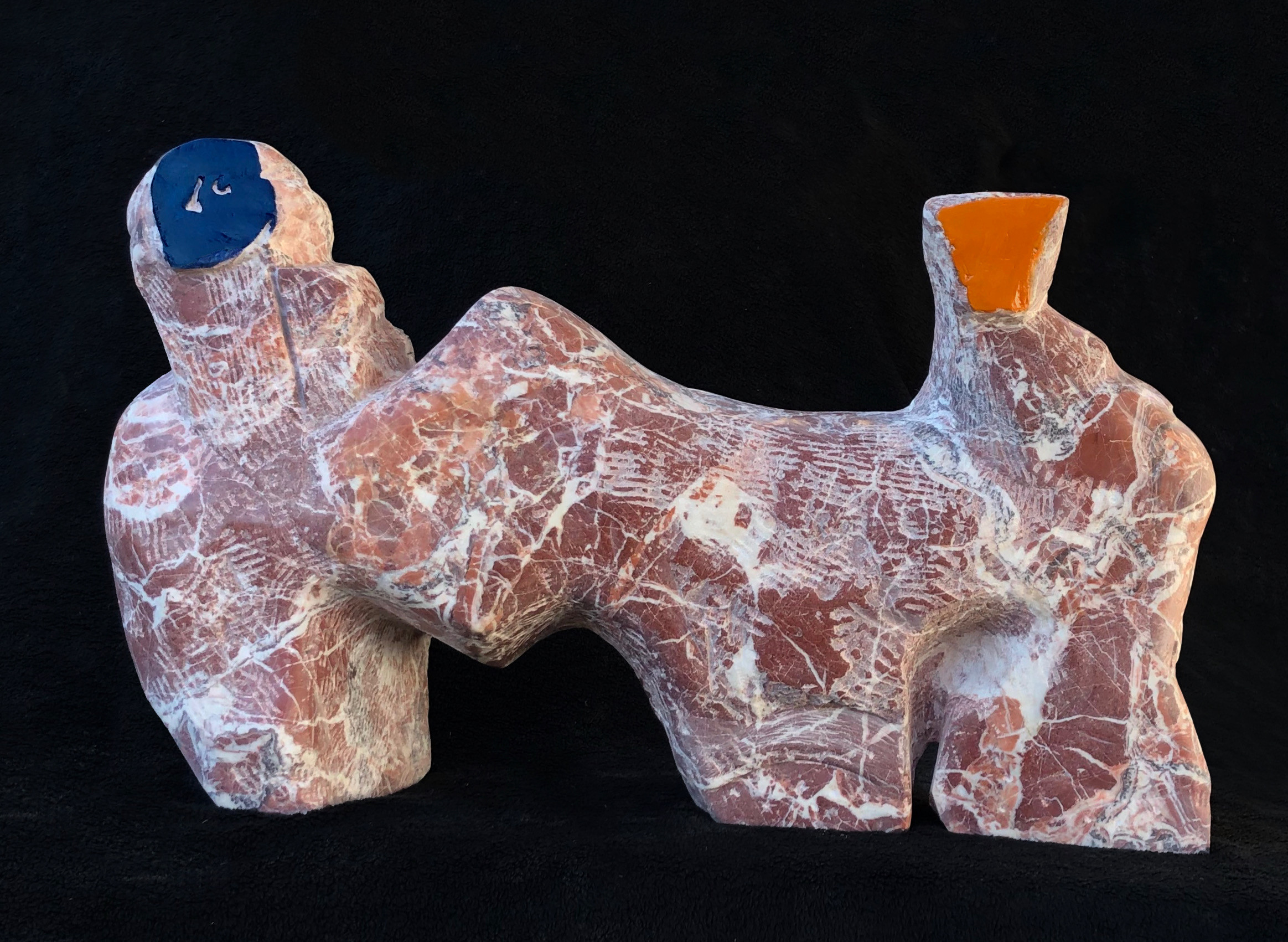
Michael Francis Cartwright, Ocean Cliff series, Two Reclining Figures, 2020, Porta Santa Verona marble, paint, 33 × 56 × 19cm
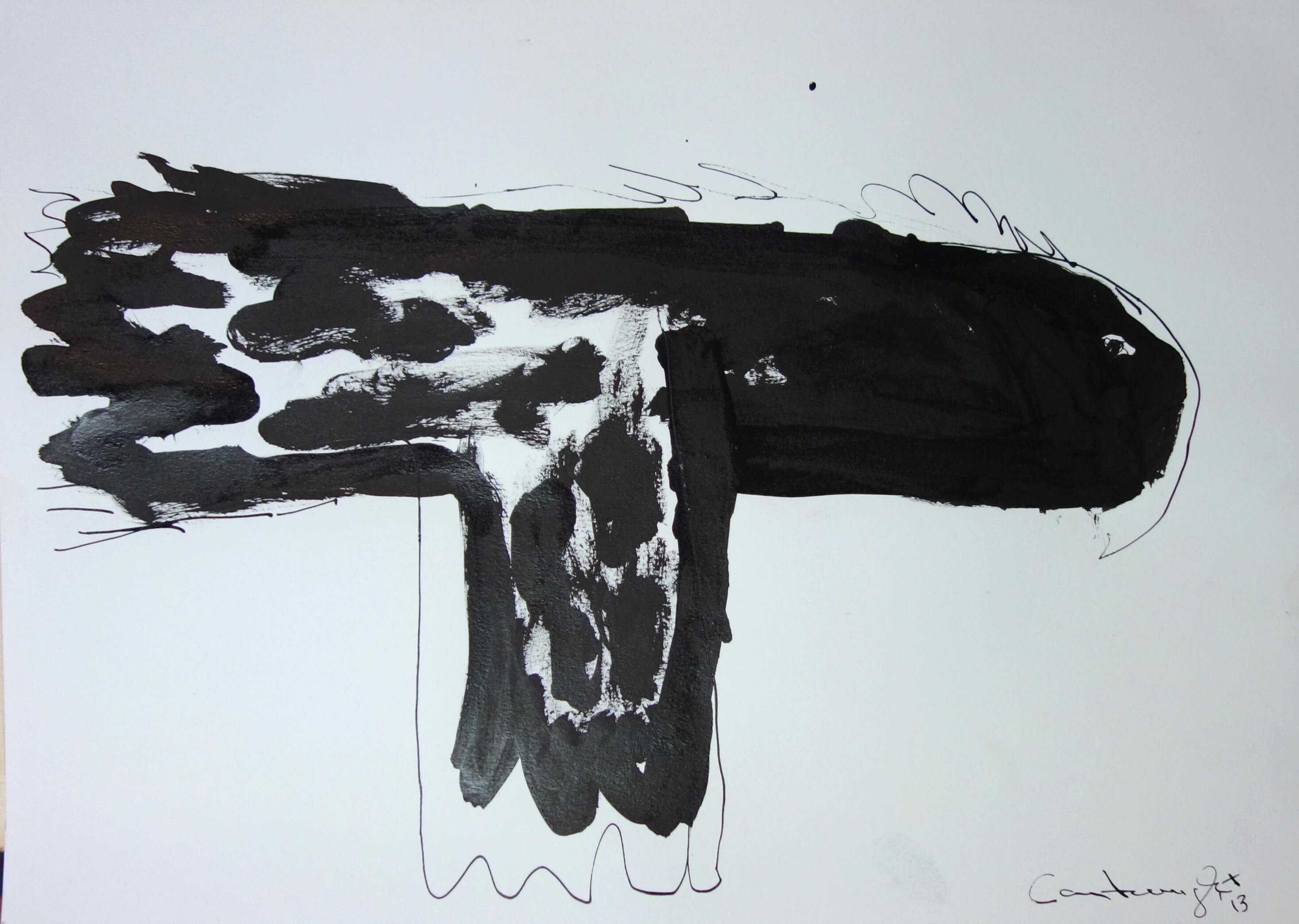
Michael Francis Cartwright, Black-Cockatoo, 2013, pen and ink on paper, 30 × 42cm
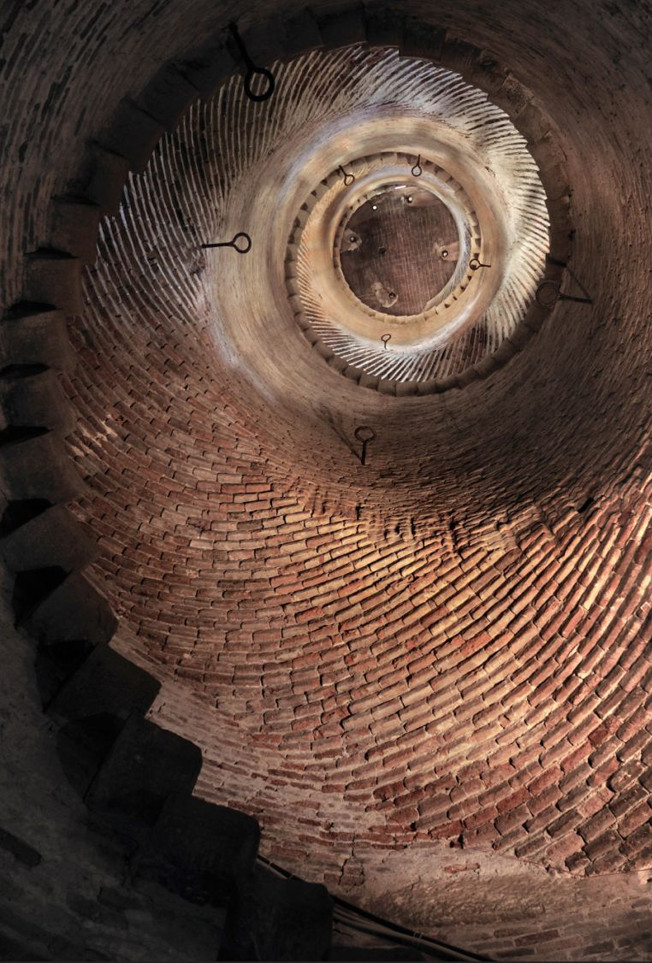
Looking up the 'corkscrew' stairwell within the San Martino bell tower. Photo: Giorgio Cespa
In the episode, Michael mentions the bell tower which may bear the mark of Michelangelo’s genius. More of this story in Art is Life.
Credits
Producer: Sarah Monk
Sound edit/design: Guy Dowsett
Music: courtesy of
Composure, Richard Lacy
Malawi Marimbas, Rob Kelly and Duncan Pittock
Assimilator 2, Sue Vernon and Paul Ressel
I don’t have a particular style, and I believe you should look for a particular style. I believe you should always be questioning what you’re doing and questioning the status quo and looking for something that you haven’t discovered in yourself to materialize in an art form. My philosophy that everything and everyone is equal, so if you talk about that, if everyone’s equal, all your materials should be equal. So you should work with them with the same respect. So whether it’s a piece of tin on the ground or whether it’s a bit of statuario from Michelangelo’s quarry, they should all be treated with the same respect and you should just work that way.
Sarah Monk:Hi. This is Materially Speaking, where artists tell their stories through the materials they choose. In this series, we’re talking to artists in Italy, in a town called Pietrasanta, 15 miles south of the Marble Mountains Of Carrara. Here, there is a long tradition of marble carving studios and also of foundries, which realize artists’ work in bronze. Today, I’m talking to Australian sculptor Michael Francis Cartwright.
Sarah Monk:He now lives in France, but has produced his art in this area over many years. We met in Central Pietrasanta, in a small public park, a little way up the hill towards old fortress, Rocca Di Sala. From here, we could look down and see the Duomo Di San Martino, which dates back to the fourteenth century, and adjacent to it, a fifteenth century Bell Tower. The piazza and surrounding streets are pedestrianised. But as always, it is busy with artists, residents and tourists enjoying the many cafes around the square.
Michael Francis Cartwright:I’m Michael Cartwright. I’m an artist. I’ve been doing my art for over forty years. I sold my first painting when I was 15. For me, art’s the main thing in my life.
Michael Francis Cartwright:That’s about creativity, about creating something the whole time. When we come here, we are coming here to usually either carve marble or work at the foundry. Carving the marble is mainly with with the pneumatic hammers and diamond blades, and that’s why we come here so we can make that noise and that dust. But after about a month, I’ve had enough, and I’m ready to go back to the peace and quiet of of my studio in France.
Sarah Monk:And what are you working on now?
Michael Francis Cartwright:I’ve just finished a project. I was going to Macau in a couple of days. I rented a studio for a couple of months, I was able to get it done quicker than I thought. So I was able to get into some works that I’ve been playing around with in my studios in France. And so I’ve been doing a series of drawings and paintings of landscapes.
Michael Francis Cartwright:I’ve always wanted to do landscape and sculpture, and so I started doing a few things like clouds on hills. I think you’ve seen some of the work.
Sarah Monk:Very beautiful.
Michael Francis Cartwright:They were my first sort of landscapes. I love that sculptural element of cloud that constantly changes and they would just sit on a hill, any hill. And it’s amazing because friends and family will send me a text with an image and go, oh, look at this great cloud on a hill. So it’s been good. It’s actually made people look at things around them and see the beauty that they would normally maybe just pass by.
Michael Francis Cartwright:We’ve spent time on coastal areas, the Southern Coast Of Australia on the Great Southern Ocean, the West Coast Of Ireland in Kerry overlooking the Atlantic, the North Coast Of France around Etrita. Beautiful cliff forms. So I’ve been drawing and painting these and while I’ve been here, I’ve been starting to carve them and they’ve become figurative. These cliff forms have started to become figurative because you walk around and go, god, look at that lion’s head. You know, look at that woman reclining.
Michael Francis Cartwright:And the beauty about this is that I mean, Henry Moore used to say, as you walk around a sculpture, there should be surprises. And I didn’t think that’s great. So when you walk around the cliffs, you’re walking from one direction, you see this beautiful reclining man or woman or lion or something. And you get halfway around, and it’s just not there. It’s something else.
Michael Francis Cartwright:So I’ve been carving these reclining cliffs. I love it. It’s great fun.
Sarah Monk:So let’s go back to the beginning. Can you tell me where you were born a little bit about your upbringing?
Michael Francis Cartwright:I was born in a country town in Victoria, Australia called Wangaratta. When I was one, we moved back down to Melbourne. Dad worked as a a Celtx rep selling oil for an oil firm called Celtx. And when I was about seven, he threw that all up and started painting. And I couldn’t believe it.
Michael Francis Cartwright:I loved it. And I’ve helped him build his first studio in the backyard. And then when I was about 15, I got sick and had three or four months at home. And I think out of frustration, dad threw me in the studio and basically locked the door behind me and said, do something. Shut up. Stop complaining.
Michael Francis Cartwright:Dad was a bit of an impressionist painter, so he was always on about the impression of something. So there was the freedom. It wasn’t about learning the anatomy of something or trying to copy a still life perfectly. It was always just about getting the impression.
Michael Francis Cartwright:So as a young artist, I think the underlying thing was about having that freedom. So, you know, it’s just to sit in the used to go to work with him sometimes since he was still working with doing Celtics, but mainly wagging.
Sarah Monk:What does wagging mean?
Michael Francis Cartwright:Oh, wagging, isn’t it that’s not an English word? That’s an Australian word? When you don’t go to work, when you just stay home. So he used to park the car around the corner because the bosses knew that he loved his painting and they’d sort of drive past to see if his car was in the driveway because he was a, you know, he was on the road selling. So then he’d walk back and get into his studio.
Michael Francis Cartwright:So he taught me two things. He taught me a bit of freedom in my art and he taught me how to wag. And which was really important, really important lessons. And so, anyway, I got into art, and then they I went to an art college, which was the freest of the art colleges back in Melbourne at the time. It was called Caulfield Tech back then. And I had a really free teacher.
Sarah Monk:What do you mean by free?
Michael Francis Cartwright:Well, you know, we didn’t have to sit down and and learn the processes, like learn how to make molds or, you know, learn how to carve or learn how to in any of the traditional things. I didn’t have to learn how to do a clay figure or anything like that. The lecturer would say, you know, so what are you gonna do this year? Yeah. Okay.
Michael Francis Cartwright:That’s great. Go for it. But being young and being, you know, flexible, I guess, he left. There was sort of a kerfuffle at the college. We moved into a new area.
Michael Francis Cartwright:We had a new lecturer turn up for the next year. And he came out from England. He was an Australian. He was one of Moore’s assistants and worked for the BBC and doing set building and things like that. His name was Stuart.
Michael Francis Cartwright:So Stuart suggested I had to finish my course and I started doing modeling and I modeled a figure. I’m probably pretty influenced by Henry Moore because this is where he came from. But I mean, I think that’s what you are when you’re young. I think if you’re if you’re honest and you just sort of relax and don’t have sort of preconceived ideas. So I ended up going to RMIT, Royal Melbourne Institute of Technology, and they had a sculpture department.
Michael Francis Cartwright:And my lecturer, the one from Henry Moore, he put me into RMIT, which was the absolute opposite. Everyone was supposed to have learned mold making and all the rest of it. And I I was put in there and met Shona. And Shona was on the other side of the wall, and every five minutes, she’d call my name out because she needed a hand or something. The rest is history.
Michael Francis Cartwright:So we’ve been together ever since. So that was I was 21. I’m 61 now. So there you go. Shona had a child straight away pretty much.
Michael Francis Cartwright:I was brought up pretty middle class. You can remember I’m 22 now. I slipped back to that thinking and thought I had to go and get a job, so I went and grabbed a job teaching. So I taught for two years, which I really love doing. I love the connecting with the kids, but needed to get back to my art and Shona was wasn’t doing her art because she felt a bit guilty that she could do it and I wasn’t doing it.
Michael Francis Cartwright:And so it was a there’s a tension and we could see the relationship falling apart because of not being able to do our art. So we sold everything up and once again because of this Stuart guy. He, you know, we came and told him we were buying a house and he got so angry with us. And then he threw us out the door and by the end of the day we’d bought tickets to Italy. True. True story.
Michael Francis Cartwright:We came to Kurara, just up the road, with Jacob, our first one. He was, like, 18. Turned two when he was here. First language was Italian.
Michael Francis Cartwright:Parents didn’t understand and kept saying, when’s he gonna speak? And someone said, he’s been speaking Italian for months. Yeah. We’re still as good at home. We’re hopeless.
Michael Francis Cartwright:Shona had a little room up the top, and I had a studio down in the valley with in Carrara proper. And so we did that, and then we came back to Australia. And our life just sort of moved on from there.
Sarah Monk:Can you tell me a little bit about the community in Pietrasanta? Because it’s quite an unusual community.
Michael Francis Cartwright:There’s lots of artists of different successes or different types of successes. There’s some artists here that have done really well in the art industry. There’s other artists that are really successful because they’re just doing what they love doing and they’re happily being in it. And then there’s a lot of artists who haven’t found that success whether financially or peace within themselves because they seem to constantly wait for that thing to happen, whatever that thing to happen is, which is really just happiness. So they’ve probably got it, but they’re just missing it.
Sarah Monk:What else attracted you to the area? You came to Kurrara, then I know you you went back to Australia. But this area, why was it so special an attraction for you?
Michael Francis Cartwright:We started coming back here slowly, but not at first. I think we were just enjoying living in Italy and finding our own life without influence of family and friends and industry. And and we came really came back here when we picked up Soleil, our youngest son, one day from the airport in Nice. He came back to be with us for a while and to sort of take stock of himself. But on the way back, he said, I’d really like to do some carving, dad.
Michael Francis Cartwright:So we said, okay. We’ll pop into the foundry and see if they know of any spaces. And then we ended up at Shakti Studios, and he started carving. And I went and joined him after a while, and I got back into marble carving. What had I been doing before that?
Sarah Monk:I was just gonna ask you, what had you been doing?
Michael Francis Cartwright:I think I was doing a lot of painting, and I was carving a lot of the Australian timbers.
Sarah Monk:What sort of work were you doing in timber?
Michael Francis Cartwright:A lot of amalgamation stuff. Australian timbers are amazing. They’re really hard and really solid and heavy. So I would find bits and pieces, and I’d amalgamate it and paint them.
Sarah Monk:Can you tell me a bit about the Australian woods that’s piqued my interest?
Michael Francis Cartwright:There’s some great hardwoods like the river red gum. It’s a really beautiful deep redwood. Big tree. They don’t get very high. They seem to get broad and break their limbs all the time, so you’re constantly finding red gum.
Michael Francis Cartwright:Then there’s things like Jarrah, I think mainly comes from Western Australia. There’s a beautiful timber called Mulga wood, which is really, really, really slow growing. Shown a card, a piece of this, and it’s a desert wood.
Sarah Monk:What color is this?
Michael Francis Cartwright:Deep red. So many woods in Australia, well, down south anyway, where I’m from, this deep red. The River Red Gum is red and the Jarrah is red and this mulga is red. It’s nearly as heavy as stone. It’s incredible.
Michael Francis Cartwright:It’s so so dense. But I’m also happy to pick up bits of pine and laminate them and carve them.
Sarah Monk:So when you came back here, what what sort of work were you doing, or what sort of work were you doing before you came back here?
Michael Francis Cartwright:Being a, you know, being a young artist, it’s difficult to get going with your art, to make enough money to to live off your work. We got to a point that we were just so frustrated that we couldn’t move on, that we couldn’t really do the things we wanted to do with our art because of the cost of materials and because you needed to live. I was offered to take part in a a course for small businesses for artists. And it clicked with me, you know. I understood it. Not that they really taught me much, but just made me rethink about how we do things.
Sarah Monk:What sort of things are you thinking of?
Michael Francis Cartwright:I guess our relationship to money. I probably had an unhealthy relationship to money. Also, understanding the concept of what wealth was, questioning the whole concept of fame that I think a lot of artists go through. They want to be famous. I’m not sure why they want to be famous because you lose a lot of freedom, I think.
Michael Francis Cartwright:I came to learn that wealth has nothing to do with the money. It’s about the happiness that you have in life. Your ability to be generous, and your happiness, your state of being of happiness. But anyway, that course taught me something. It got me going.
Michael Francis Cartwright:Oh, we had to learn stupid things like business plans, which actually centered us. We were able to sort of differentiate between what was your studio and what was your business. And to this day, we we allocate a small amount of time to our business each week, And that helps direct us towards achieving those other goals that, like, you know, the goal of perhaps wanting to do a big bronze or or or or having collectors that follow you. You know, how do you so it made us question about how we go about those things. Aren’t that belts?
Sarah Monk:We’re sitting in the center of Pietrasanta. Tell me about that tower, though.
Michael Francis Cartwright:I’m pretty sure that Michelangelo, along with someone else, designed the tower. And the inside of the tower is a spectacular corkscrew effect for the staircase. So the bricks just sort of morph out into a thread, and you walk up the thread to the top. Pretty. And the outside is it’s not finished.
Michael Francis Cartwright:The outside is supposed to have these big bulbous pieces of marble all the way up to the top, which would have been amazing. I don’t I haven’t seen any other design like it, but it didn’t happen. I think his project for one of the church facades in Florence came through, so we just moved on. But it’s amazing they are finding little bits and pieces of Michelangelo stuff everywhere. The little village that we lived in in Ortonovo, which is above Cloudera, has two churches, and one of them, they’ve discovered since we were there.
Michael Francis Cartwright:And the porticoes, there’s a little carving by Michelangelo. Just sitting there. No one knew.
Sarah Monk:That’s amazing.
Michael Francis Cartwright:Yeah. So it’s pretty lovely. And I’m sure there’s other bits and pieces everywhere. I think there’s a wooden crucifix in the Massa Cathedral as well. Yeah.
Michael Francis Cartwright:So it’s pretty nice being here walking around and sitting at Bar Michelangelo where we used to live and so, yeah, I’m a bit of a romantic like that.
Sarah Monk:When you spoke earlier about how at college you were encouraged to look at the business side, some artists maybe feel that commerciality’s dirty word or something. What what do you think?
Michael Francis Cartwright:I wasn’t taught at college. In fact, it was the opposite. It was something that the government dished up to me because I’d been on the dole for too long, basically, which came at a good time. It’s not about being commercial. I mean, remember there was an artist who I happened to run into in in our little town in over the hills where we first were.
Michael Francis Cartwright:I only saw him once. I never saw him again. An English guy. He’s a painter. And he said the difference between a commercial artist and a not commercial artist is the commercial artist has found his clients.
Michael Francis Cartwright:The art shouldn’t change. You gotta find the people who like that. You know? And I mean, I as as a young artist, I used to, you know, go and have an exhibition, and I would tell the gallery what I wanted to put in. But, really, that was the wrong way about it, and the gallery should have known this.
Michael Francis Cartwright:The gallery should have come to my studio and selected the work that fits the space.
Michael Francis Cartwright:Yeah. You should be just selecting the work that fits the gallery if you wanna be in a commercial gallery. If you want to do something else that’s not commercial, do whatever you want to do. But don’t expect commercial success if you’re not going to look at the commercial needs. So I always do what I want to do.
Michael Francis Cartwright:And then I sit back and I go, this piece is obviously for me. You know? And these pieces are, you know, like the gallery in Australia might work with these. I still love painting the Australian cocky. You know?
Sarah Monk:What’s the Australian cocky?
Michael Francis Cartwright:Cockies. You know, the sulphur crested cocky, the the the black cocky. Just the black cocky. Yeah. They got beautiful, you know, red plumes and yellow plumes and amongst the black, and they squawk and they hang upside down and they farmers hate them.
Michael Francis Cartwright:They eat all the rubbers off the nails on the roofs and the roofs fall off and they eat all the all the seeds and they’re the most beautiful birds out. And I love painting them, you know, but I’m not gonna presume that I’m gonna sell them in Provence. You know? I don’t care. And I love painting Provence.
Michael Francis Cartwright:I love painting the coast of Provence, and I’m not gonna take them back to Australia, but I’m still gonna do them. Marketing, we all do it, you know, whether you like it or not, whether you yeah. Marketing is about putting the thing that you want out there in front of the people who want it. And so if you think you’re not gonna do marketing, you’re doing it every time you put an exhibition on. You’re either doing it well or you’re doing it badly.
Michael Francis Cartwright:So you might as well do it well. I think artists are a little bit addicted to exhibitions, which we don’t need to be. There’s other ways of doing things, especially these days. Men, Michelangelo, we talk about Michelangelo here. Don’t think he ever had an exhibition. You know? So you don’t have to.
Sarah Monk:So because you were a teacher when you were younger, not that you’re that old, Michael, but do you have any advice for young artists?
Michael Francis Cartwright:Stay true, man. Just do it. Just keep doing it and find a way of doing it. And the way that suits you, there are no rules. Just be open to the things that speak to you about making it easy for you to do your work and to be able to enjoy your life while you’re doing it.
Michael Francis Cartwright:It’s about being happy and it really is about being happy because I believe you should just do your art.
Sarah Monk:What are your inspirations for the work starting back from this period in Australia when you were working with woods?
Michael Francis Cartwright:Well, you know, I wasn’t only working with woods. I was painting. I was doing a lot of drawing. At the time, I was pretty involved with an artist group in Castlemaine, which was the big influence. Ran that for a little while.
Michael Francis Cartwright:I had a friend, a fellow artist called Greg Smith who still lives there, and we used to have what we call kindergarten time. And we would get together in my little old studio in the backyard, and we’d go to op shops and find bits and pieces, old toys, bits of stick, anything. And we would play and put things together, and then take them to the local art foundry, which we were lucky there was one around, called Garage Art Foundry at the time. And we would go there and get them cast in bronze, all sorts of little things. And then there was there’s an old jail there that had just closed down, and they asked would someone do an exhibition there.
Michael Francis Cartwright:So along with Greg and I, we had like five days to fill the jail with artwork. Of course, it wasn’t sculpture. It was a bit not quite long enough time. Would have need seven days for that. And so I went to the hop shop and found sheets and I painted sheets and hung sheets and I did lots of drawings on big drawings on paper, mainly all portraits.
Sarah Monk:What sort of portraits?
Michael Francis Cartwright:Me as a convict because well, cause um i don’t know. I was the only person I could draw that I didn’t have to pay. But also, I came out, our family came out as convicts too, so it was sort of appropriate. You know?
Michael Francis Cartwright:So I would do anything. I mean, ah, tin. I remember that we had this old truck, and I really liked the doors of the truck. I took the doors off the truck and cutting them up and turned them into a sculpture and bent them and
Sarah Monk:Did you end up with a truck with no doors?
Michael Francis Cartwright:No. I took the whole back off and just turned it into a tray and used all the tin. Shana was a great lady. She let me do things like that all the time, you know. And so we had a bit of a history of being a bit freer and relaxed about things like that.
Michael Francis Cartwright:I’m sort of, like, not precious about the materials. It’s the materials have just got to work for that particular thing. I love painting. I love doing printmaking. I love working with found objects.
Michael Francis Cartwright:I just like doing anything that’s around. And while you’re here, because there’s just lots of marble around, you tend to do marble.
Sarah Monk:So thanks to Michael Francis Cartwright. You can see his work on Instagram @noonan.cartwright.art or on his website noonan-cartwright.com. For photographs of all the work discussed today, follow our Instagram or visit our website, materiallyspeaking.com, where you can join our mailing list to hear about upcoming episodes. Editorial thanks to Guy Dowsett.