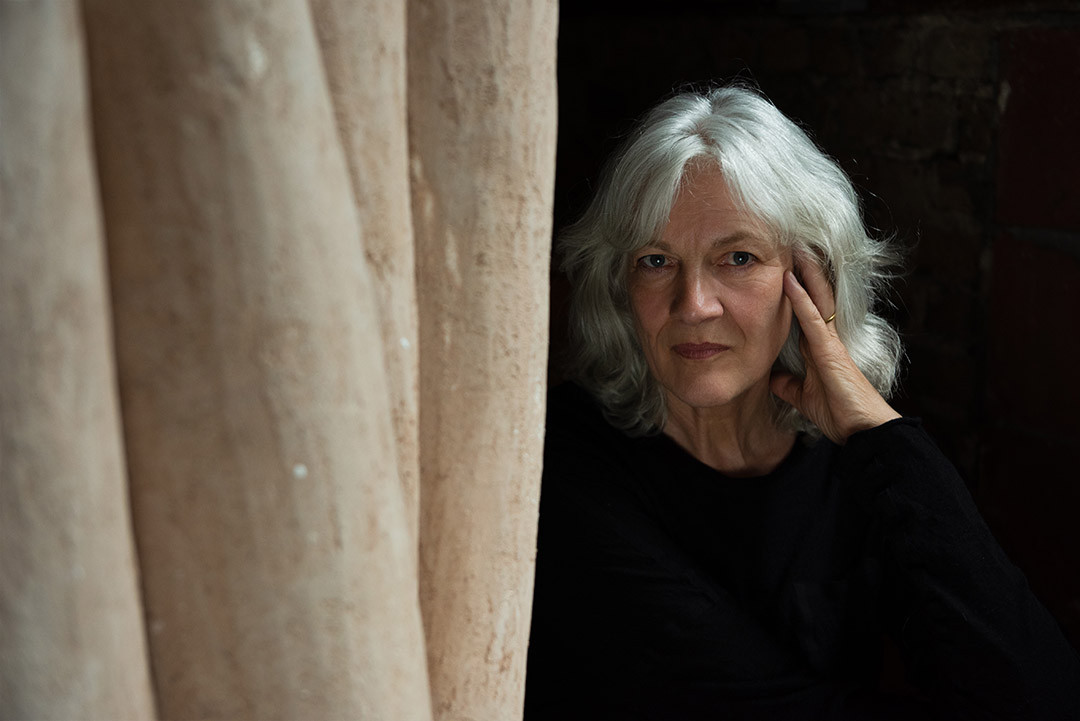
Photo: Genevieve Stevenson
When Almuth Tebbenhoff came to London in the late 1960s she started from scratch: learning a new language, finding a job and studying to be a potter.
A decade later, a lucky meeting with Eduardo Paolozzi gave her the chance to study at the Royal College of Art where drawing classes, lectures and conversations with other artists led her from the world of ceramics into one with a wider range of materials.
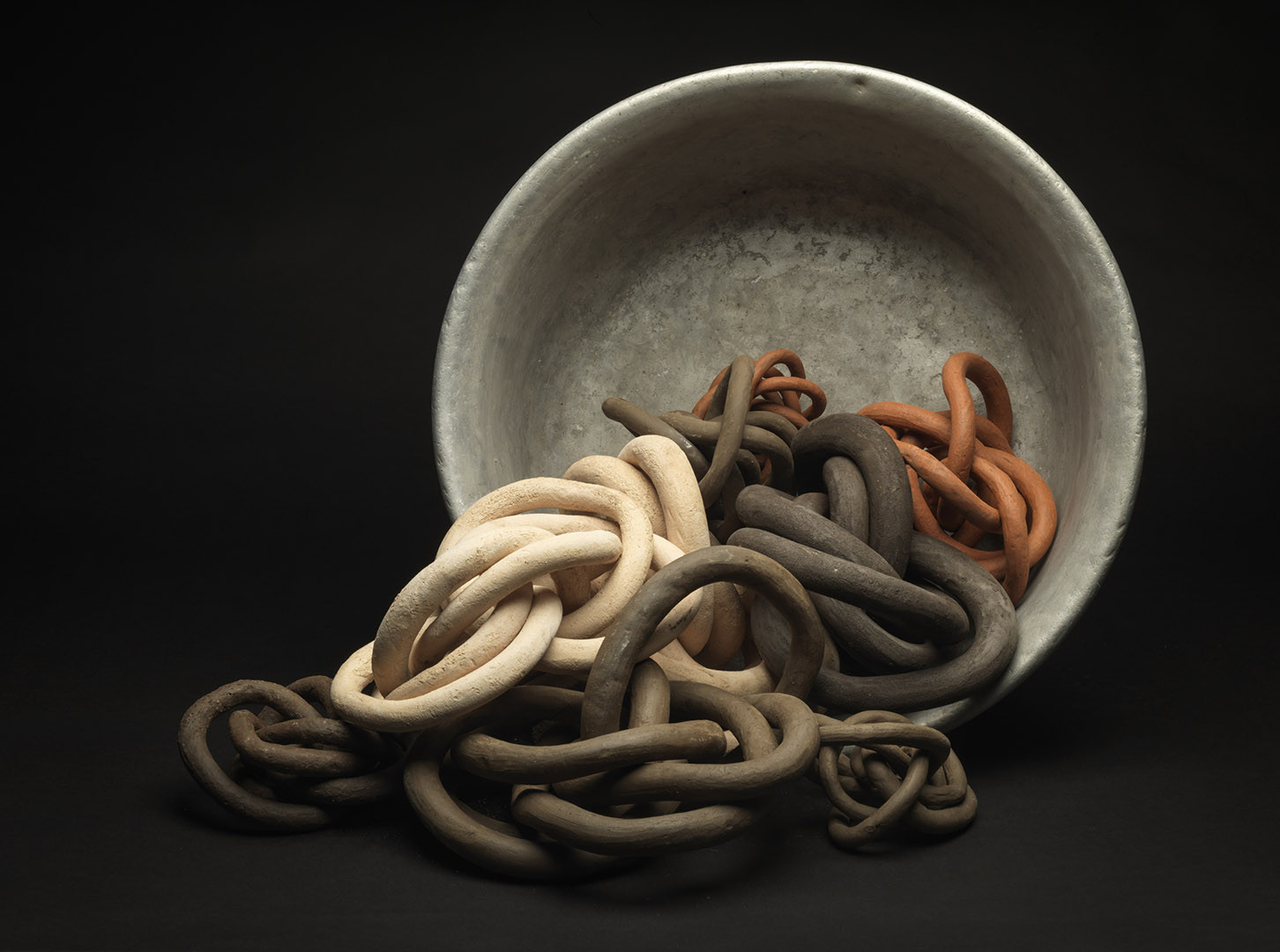
Almuth Tebbenhoff, Untitled, 2020, fired clays
Almuth first came to Pietrasanta to work in marble in 2006. She talks about a few special projects she created in stone including a series of interlocked nutshell type boats, which appear to toss and turn on their journey.
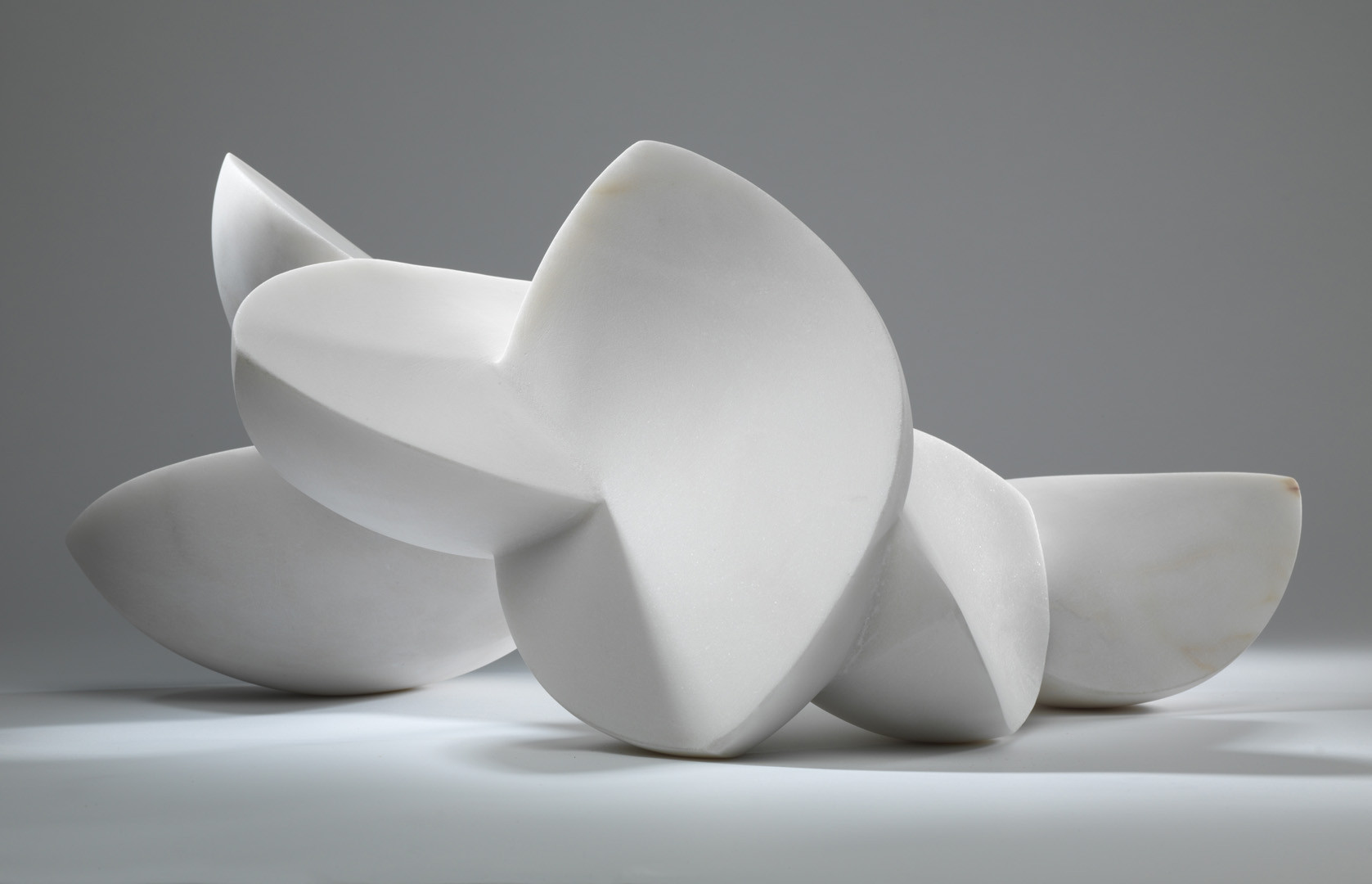
Almuth Tebbenhoff, Voyage in a pale boat, 2016, Portuguese pink marble, 28 × 58 × 39cm
Another commission, Flow, lived outside the Salisbury Museum reflecting Almuth’s fascination for patterns made by water. It's this piece which she was restoring on the day Sarah Monk went to interview her at Studio Sem in Camaiore, just south of Pietrasanta.
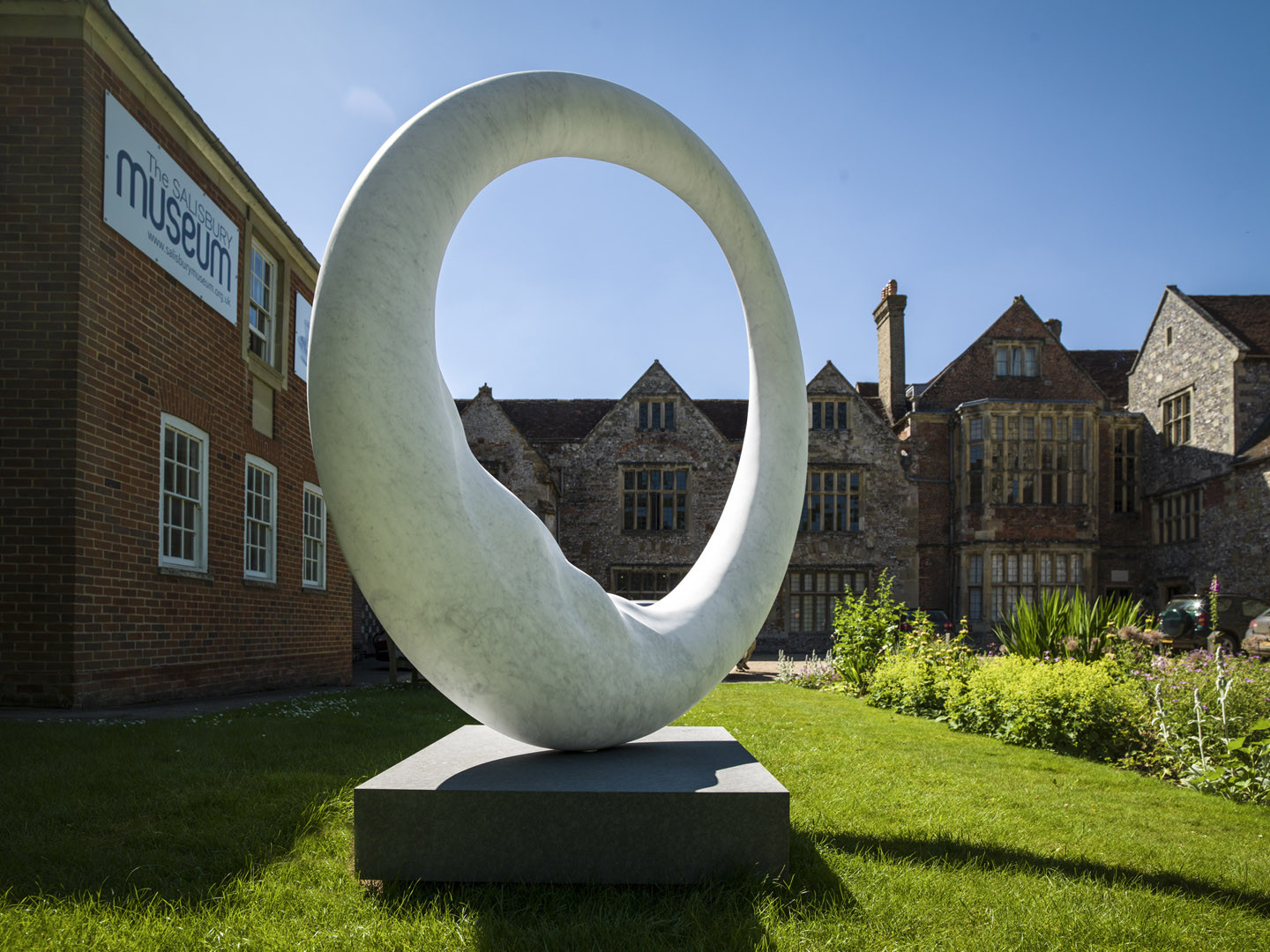
Almuth Tebbenhoff, Flow, 2018, marble, 210 × 195 × 65cm plus base, Salisbury Museum
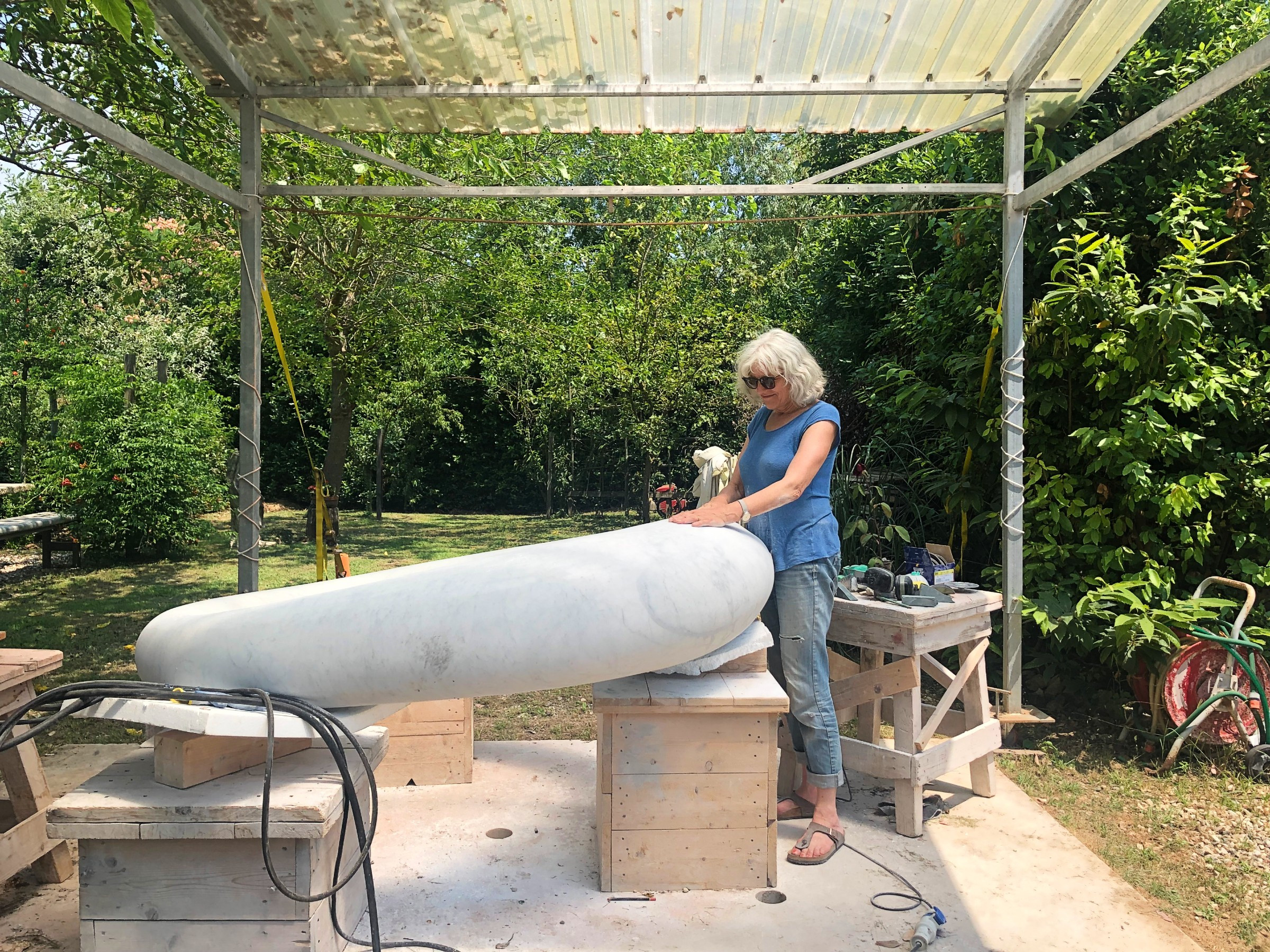
Repairing Flow, 2019, Studio Sem
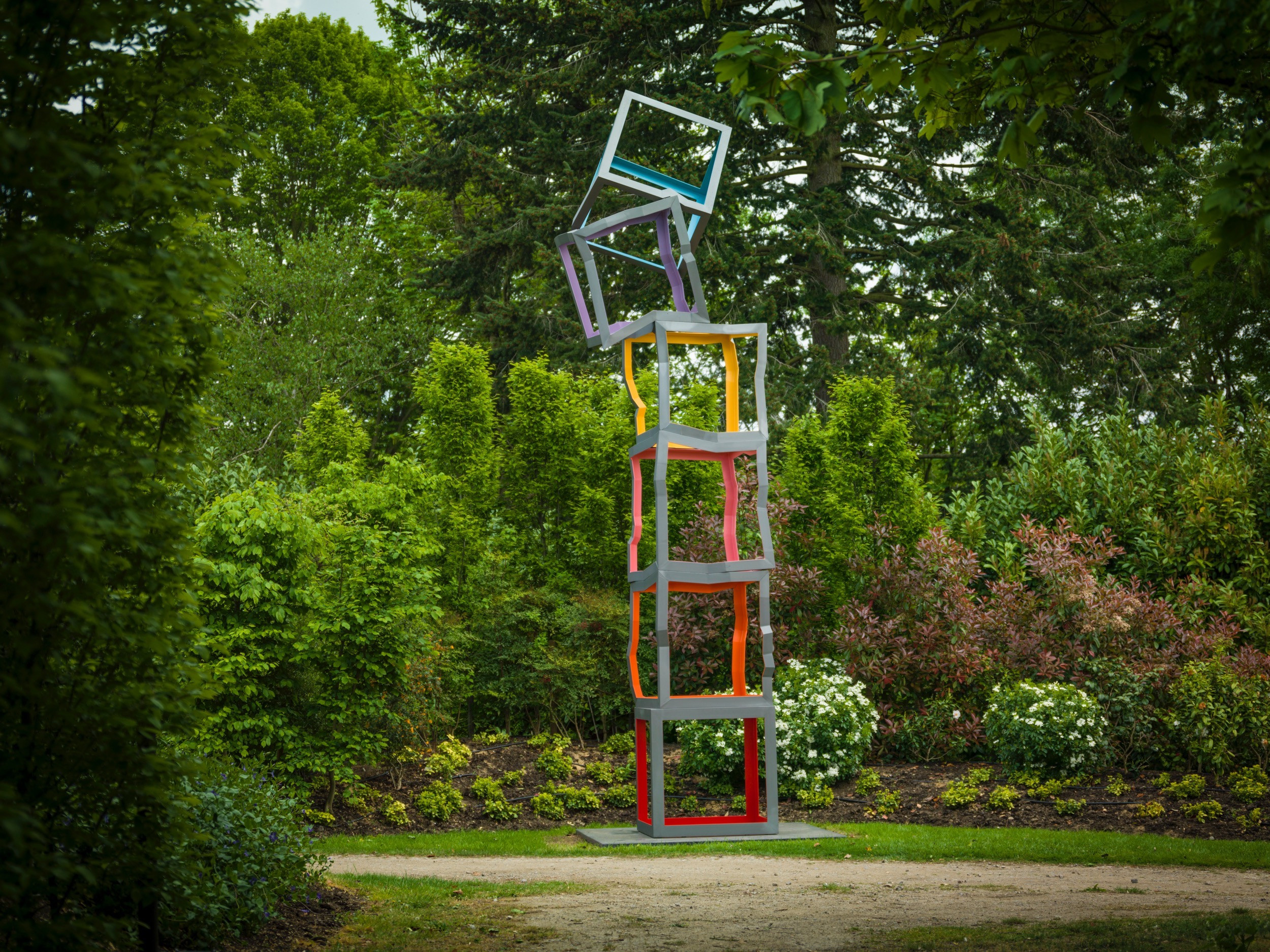
Almuth Tebbenhoff, Sunset stack, 2019, fabricated steel, paint, 670 × 110 × 140cm, Quenington, Gloucestershire. Photo: Steve Russell
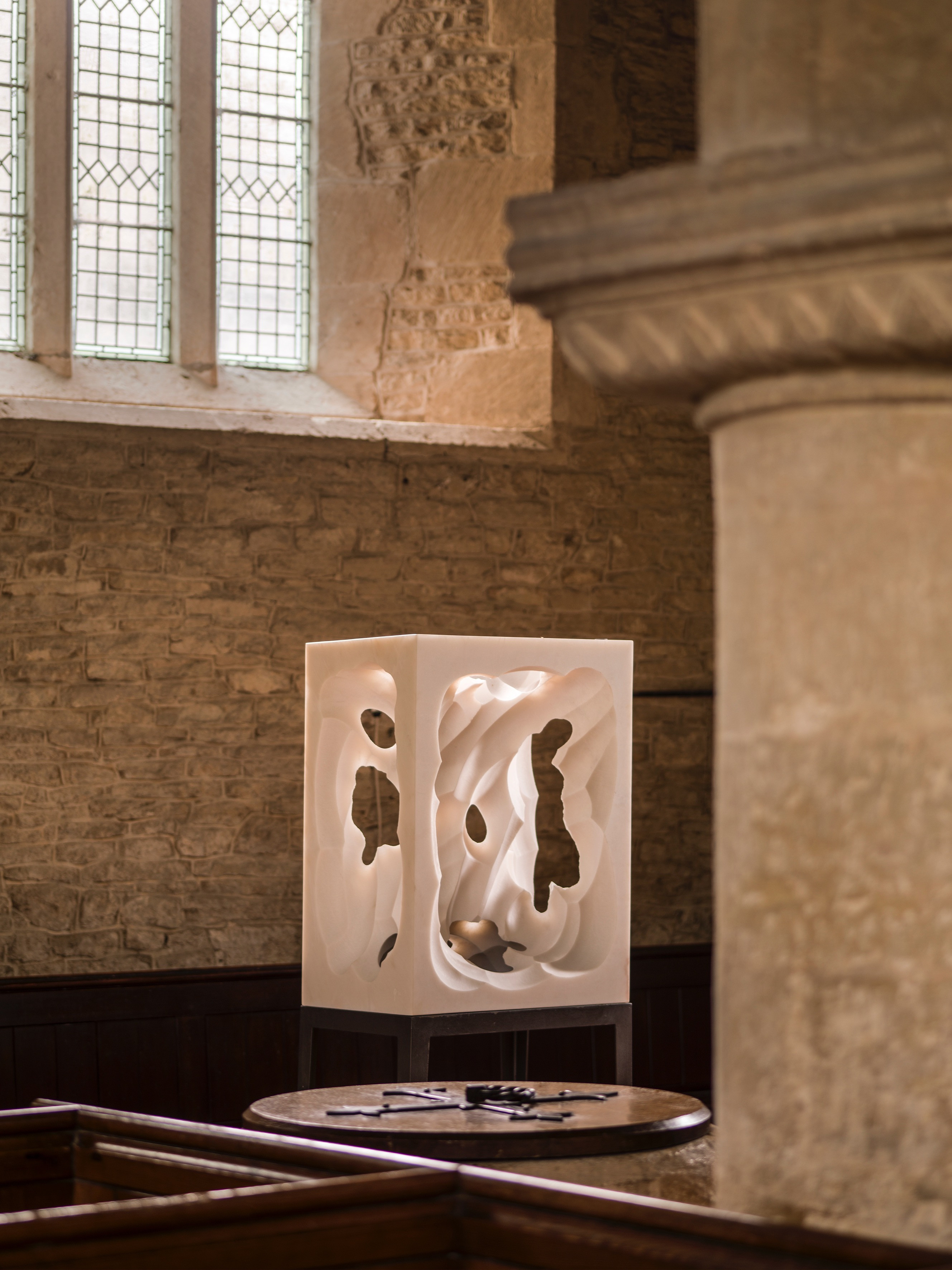
Almuth Tebbenhoff, Indensity, 2014, Portuguese pink marble, 80 × 60 × 40cm. Photo: Steve Russell
Links
instagram.com/almuthtebbenhoff
Almuth is vice-president of the Royal Society of Sculptors
In this episode Almuth refers to:
Credits
Producer: Sarah Monk
Editor: Michael Hall
Music: courtesy of
Silver Lining by EDH Music, London
Strata by Moby courtesy of mobygratis.com
Hi. This is Materially Speaking, where artists tell their stories through the materials they choose. In this series, I’m talking to artists working in a community in Northern Italy, which has specialized in carving marble since before Michelangelo came here five hundred years ago to source marble for his Pieta. Artists come here for the choice of marble and the experts who help them work in it, from artisans and studio heads to the specialist services like tool shops, cranes, box makers, and, of course, the shippers. Today, we’re between Pietrasanta and Camayori, about thirty five minutes by car to the North of Pisa in Studio SEM, founded by master marble carver, Sem Gellardini, in the nineteen fifties.
Sarah Monk:Semm was one of the first studio heads to invite international artists to come to realize their work here, and his reputation for passionately supporting his artists is continued today by the current studio head, Keira MacMartin. Today, I’m talking to Almuth Tebbenhoff in the orchard at the
Almuth Tebbenhoff:back of the studios. My name is Almuth Tebnenhoff. I was born in Germany, and I came to England when I was 17 because I was born on a farm right in the middle of nowhere, and I was looking for art. For some reason, you know, people have this. I knew I wanted to be an artist, and this local farming community didn’t really offer anything in that way.
Almuth Tebbenhoff:So I I was kind of on my own and thought I’d try London. Now that was 1968, which was a very exciting time, and it beat, you know, sort of potato growing and that kind of thing that you get on a German farm. And I I just stayed. I loved it.
Sarah Monk:And what what sort of art were you doing at that time?
Almuth Tebbenhoff:Well, as a kid, I’d always sort of messed around with clay and done some painting and drawing and, you know, usually painted pretty ladies with big eyes. That’s the sort of thing I’d want it to be. I wasn’t at all formed in in any way or trained or whatever. I was I think I was quite good at capturing textures and forms and that sort of thing. So I had been encouraged at school to do stuff like that, but they couldn’t help me any further.
Almuth Tebbenhoff:Once I got to London, I had to basically start from scratch. I had to invent myself. So I first thing I did was get a job as an au pair girl. I took some language courses. It took me another five five or so years and also getting married in between before I could start on my art career, which I did as as a potter.
Almuth Tebbenhoff:I went to a to a ceramic course at Sir John Cass School of Art, which in those days you could walk in and say, I’m so passionate about it. And they’d say, yes, come on. You just pay your fee and you’re on. And I did that. And that gave me a really good grounding in the craft of working with materials.
Almuth Tebbenhoff:It helped me be really quite patient, which I think is is necessary because you really need to learn something from scratch and devote a lot of time to it. In in this day and age of social media and all that can be very considered to be boring, but it’s not. It’s really wonderful to sort of discover your response to a particular earthy material. Then I was very lucky because I met Eduardo Paolozzi in the late seventies who said, you’re not a potter. He said, that’s for housewives to kind of wrestle with. Come on. You just come to the Royal College of Art. We’ll open the doors for you. You know, just come to lectures. Help yourself to anything.
Almuth Tebbenhoff:If anybody asks, say, Eduardo says it’s alright. So I did that, and it was incredible. For a year, I could string it out before somebody said, Well, hang on, you’re not signed up. You haven’t paid anything. So that was the end of that stint.
Almuth Tebbenhoff:That intervention by Palazzi was just invaluable, and it just opened the world of art and what people could do and the amazing things that could be achieved. The effect that had on me was that I went to fabrication classes because ceramics became too small. I mean, things if you wanted to make something big, it either exploded in the kiln or it became problematic for technical reasons. Since my dad had always been a hobby blacksmith and he had a sort of welding equipment and all that, I took that with me when he died in ‘84. And I took it back to London with me and started to learn how to do that in a fabrication course.
Almuth Tebbenhoff:So I learned really to fabricate properly like a a welder rather than an artist. When you make something big, you can trust that the weld is going to hold and it’s not going to be porous and fall to bits. I was then set up with a much larger palette. My basic work kit had expanded enormously, and I could do all sorts of things. I did some things in combination with ceramics and with steel, but they didn’t work too well.
Almuth Tebbenhoff:But the steel really took off. I made a lot of steel sculptures for the wall and freestanding. Bit by bit, I worked my way through art history and through through astronomy. That’s been always interesting for me because it’s the I think every human being who looks up at the into the sky and sees the beauty of of the stars twinkling. I mean, you just can’t help but be drawn into it and respond to it. So that had always been something for me.
Almuth Tebbenhoff:An important exhibition for me was an invitation by the Giorgio Bank Science Centre to make an exhibition there. And I did that. The Jodorbank Science Centre is near Manchester up in Cheshire, and it’s it’s got the biggest radio telescope in, I don’t know, in England? Certainly.
Almuth Tebbenhoff:That’s the sort of home of the Astronomer Royal who opened my exhibition there. But the exhibition then moved into different territory because before I had been very geometric and clean, minimal, and suddenly faced with all the vast phenomena that was out there like black holes. It just blew my mind, and I started making things that were very different. And that is basically a discovery that I’ve been using ever since, which is that, you know, nobody’s perfect. Everything comes with crinkles and, you know, damage and irregularities.
Almuth Tebbenhoff:You know, the whole exciting world of reality. That’s been my my world ever since. Out of the blue, more or less, I was offered an opportunity to look at marble. And that came through Helaine Blumenfeld, who’d been a very prominent figure in the Pietrasanta area. And she’d said, well, if you’re interested, why not come and have a look?
Almuth Tebbenhoff:And so that was another thing that really kind of blew my mind. It meant working with something entirely different. With steel, you have structures, and you fabricate, you construct, you create a skeleton, maybe. With marble, you have to deal with volume, with weight. For me, it sort of required a completely different way of thinking, something that I had never even entertained.
Almuth Tebbenhoff:You know, sort of I thought this is far too heavy for me. I can’t possibly be doing that yet. I mean, I’d always have done things by saying yes when opportunities offered themselves. And so I thought this is an opportunity that is not to be missed. I I came, and I just fell in love and then had a a huge struggle to convert my brain from thinking steel to thinking volume and marble and all the qualities that marble offers.
Almuth Tebbenhoff:I just loved it, but it kind of initially didn’t really love me because I didn’t know how to handle it. It was a huge, huge struggle for me. I think it probably took the best part of five, six years before I felt I’d made the first really sort of reasonably good thing. Mean, marble is such an extraordinary material. You can trace the geological formation, the pressures, movement inside the earth that had happened to create the marble when it was still in a fluid state before it compacted and became what it is now.
Almuth Tebbenhoff:And to really appreciate that, I felt too much in awe of it. Whereas a lump of steel, yep, if you mess it up, you cut it up and re weld it, and you can do something. But if you mess up a piece of marble, you’ve destroyed a bit of earth, something that’s really precious, and that can never be that again. I needed a long time to get my head around that.
Sarah Monk:Can you describe your work in marble?
Almuth Tebbenhoff:My work in marble is basically abstract, but it is very heavily linked to the earth. I mean, there are things that come into it that may be the flow of water or a tree trunk. I don’t want it to be literal because what really motivates me is far more the human interaction. I mean, psychological responses and emotional responses and spiritual responses to being alive. I mean, at the moment, I’ve been working with water and the effects of water, you know, the sort of the hollowing out a stream of water can do, like smoothing of a pebbles.
Almuth Tebbenhoff:You know, the effect that maybe wind has on a on sand, like sand dunes, the sort of ripples. All of those naturally occurring things I find just sort of beautiful.
Sarah Monk:So can you tell me about a couple of your favorite pieces that you’ve done in marble in the last thirteen years?
Almuth Tebbenhoff:I’ve made a couple of pieces, big pieces, but they came out of several lots and lots, in fact, of smaller pieces. And they were based on boat shapes, which came to me after I think I was dreaming I was on the ocean in a little nutshell type boat, and somehow these boat shapes really intrigued me. Again, because they are linked, you know, they’re linked to nuts or seeds, you know, natural things. I interlinked several. I made them initially in clay, sort of fused them together in in various poses so they look like they are really in the open sea and tossing and spinning and, you know, really unstable.
Almuth Tebbenhoff:I think I did a couple of them which had three and four boat shapes. One of them is now in Hong Kong. The other one is in a in a sculpture park in Germany, also about nearly two and a half meters high. They have quite a presence.
Sarah Monk:What about the piece that you’re working on at this minute?
Almuth Tebbenhoff:The Anello flow is an important piece for me. I stuck my neck out rather a long way because it was I was offered an opportunity to have an exhibition outside Salisbury Museum for a year. This was one of the pieces that I had been queuing up in the back of my mind for something that I really wanted to to make, and I took that opportunity. That piece was exhibited, and it looked absolutely wonderful. And in the deinstallation process, a slightly inexperienced deinstaller managed to knock a little ding into it.
Almuth Tebbenhoff:I’ve managed to shave it, you know, repair it by by slightly altering the flow. I mean, that’s something you can do when something flows. And luckily, there was enough material for me to repair it. It’s one of my favorite pieces, and I was pretty gutted when it happened, but seems to have survived it. So
Sarah Monk:So you’re restoring it as it were, and then where is it going after this? Is it back to Salisbury?
Almuth Tebbenhoff:Somebody is interested in it, but we’ll have to see, but I’m gonna set it up here in Studio SEM Sculpture Garden and look forward to seeing it again on the vertical.
Sarah Monk:Have you worked at Studio SEM for many years?
Almuth Tebbenhoff:Only ever worked for studio with Studio SEM because that’s where the initial residency came about. So since 02/2006.
Sarah Monk:And what does it mean to you to work here?
Almuth Tebbenhoff:I just got to know people. They’ve it’s a fantastic team. I’ve I’ve managed to get to know nearly every of the other artists who are working here from time to time. I’ve got a terrific friendship with Kiera, who has been incredibly supportive. You know, I trust her advice because she’s done it for far longer than I have.
Almuth Tebbenhoff:If it means buying a stone, she’ll help, and she’ll advise me. Sometimes she’ll discourage me and sometimes she’ll encourage me and sometimes I ignore her and sometimes I don’t. So we’ve got a really good friendship and it works well.
Sarah Monk:And how about the resources of this area? What do you find in this area apart from the material?
Almuth Tebbenhoff:One of the really important facilities is friendships. You know, for other sculptors to be able to sit in the piazza over over a glass of wine. I mean, you wouldn’t believe what we talk about. It’s just, you know, sort of the whole world is is somehow chewed over and, you know, maybe being understood just a little bit better for lots of different people’s opinions, inputs, and the artist talked about much. A lot of artists work very much in isolation.
Almuth Tebbenhoff:Whilst you do in some ways, you create from a lonely place. It is very important that you don’t lose touch with other people and exchange ideas and create friendships.
Sarah Monk:Have you got any advice for a young person, a young artist wanting to try marble?
Almuth Tebbenhoff:Definitely, yes. Do it, do it, do it. Because I think it’s a very, very good thing, because it teaches you to be patient. And I think in this day and age, time is so incredibly precious and pressurized. People don’t take enough time over something that is slow and contemplative to make yourself familiar with the material.
Almuth Tebbenhoff:And and you can only do that through the craftsmanship. I think it’s an important process. And then you can go and do something fast. I think it’s quite nice to balance things. I do that quite a lot, that I actually balance something, a speedy process, but the slow one.
Almuth Tebbenhoff:We’re humans. We’ve got hands. We we’ve got hands that want to touch things and get certain satisfaction from making things and from touching. So that’s kind of left out of it if you just use the brain.
Sarah Monk:What’s the proportion of commissions and work towards your own shows or if you have galleries that you work with, how does it work the other the commercial end?
Almuth Tebbenhoff:Right. The commercial end is is actually quite interesting because if you are tied up with a gallery, they really prefer it if you can turn out the same stuff. So, you know, it it makes sense marketing wise because, I mean, people love a label. If you’re an artist who is developing all the time and creating work from, let’s say, from the origins as I do. I mean, I tend to draw my inspiration from nature and therefore things change as nature does and as my skills change and develop and all that.
Almuth Tebbenhoff:And I would hate to be just identified with one thing and left to do just one thing. Over the years, I’ve built up my name enough to for people to come to me. Big pieces I will do to commission unless I get so carried away. Well, that’s dangerous. I mean, I’m the sort of person that can look into the sky for hours or look at at the sea and watch waves rolling in or watch fire flicker.
Almuth Tebbenhoff:I mean, it’s it’s it’s that thing that is mesmeric, and I think that comes into my work. It’s force that’s so much bigger than I am, and I like that. All of the things that are bigger than me.
Sarah Monk:Thanks to Almuth Tebbenhoff, you can see her work on her website, tebbenhoff.org, and follow her on Instagram, @almuthtebbenhoff. For photographs of all the work discussed today, follow our Instagram or visit our website, materiallyspeaking.com, where you can join our mailing list to hear about upcoming shows. Editorial thanks to Michael Hall.